
DELIBER(AI)TION
A place to pause the noise and think critically about AI through grounded posts and purposefully small conversations. deliber(ai)tion complements our mission by creating space for collective understanding, thoughtful debate, and responsible direction-setting.

attend LIVE DELIBER(AI)TIONS
The best way to make sense of this moment is together. Join our casual virtual conversations to explore new developments in AI and share practical insights and use cases.

THE FRAGMENTATION TRAP
We have a transformative technology in front of us. And yet, much of the conversation about AI has narrowed to cost savings, headcount reduction, and surface-level productivity gains.
This isn’t a technology problem. It’s a strategy problem.
When leadership fails to communicate a clear vision, the burden shifts to individuals to “figure it out.” The result isn’t transformation; it’s fragmentation.
There is another path. But it requires alignment before acceleration.

AI Fails WHEN WE DON’T CONSIDER How Work Is Done
Many AI initiatives stall not because of model limitations, but because they’re disconnected from how work actually happens. Drawing on product and systems experience, we contend that real value emerges when teams shift from technical capability to lived experience and treat human stories as core infrastructure, not a soft add-on.

AI Is a Systems (Not Solutions) Problem
AI is often evaluated as a tool. But its real impact shows up in the systems it reshapes: work, governance, dependency, and power. Explore why better AI decisions come from looking beyond performance metrics and involving the people closest to the work.

MORE POWER!
What a 90s sitcom can teach us about today’s AI arms race. A meditation on power, restraint, and why the most meaningful uses of AI may come not from scale, but from intention.

WHAT IF AI IS A BUBBLE?
A new kind of headline is appearing: What if the AI boom is a bubble? Given the scale of investment and the mismatch in results, the real surprise would be if it weren’t. But bubbles don’t invalidate the underlying technology — they expose where strategy gave way to hype. The path forward is the same as it's always been: ask better questions, center people, and focus on meaningful, durable value.

WHAT AI BOOKS TO READ, VOl 1
We’re surrounded by quick takes and hot opinions about AI, but real understanding takes time. What AI Books to Read, Vol. 1 kicks off a continuing series of thoughtful reading recommendations curated by Erin, founder of orient(ai)tion. Each book offers a different lens on where we are, how we got here, and what kind of future we can still design…if we take the time to learn.

AI, WORKSLOP, AND DOING BETTER
AI promised to boost productivity, but in many workplaces, it’s creating a new kind of mess: workslop—low-effort, AI-generated output that looks fine at first glance but lacks real value. This isn’t a failure of the tools, but of how we’re using them. In this piece, I dig into how we got here, what the research says, and why common-sense strategy and human judgment still matter.

the COST of ‘just use ai’
Telling employees to “just use AI” may seem efficient, but it creates fear, shadow use, and short-term thinking. In reality, automation often creates more human work, not less. The real value comes when AI is used in good faith to push roles further, improve products, and build long-term growth.

The Missing Link in AI strategy
Human-centered design may feel like an outdated term in an era of AI. But its spirit of care, curiosity, and clarity has never been more relevant. We’re missing an opportunity to use decades of expertise to guide this moment with wisdom.

THE AI SPARKLE TRAP
AI adoption is happening fast, and much of it in the shadows. Employees are experimenting with tools on their own, while leaders chase the next big thing. The problem isn’t enthusiasm — it’s tool-first thinking. When organizations slow down and cut through the hype, they find the real value.

The Future We Choose
The question I keep circling back to is: How do we handle this shift better than the last one? What did we learn, and how do we apply it now?
To start answering that, I’ve developed a framework — less “how quickly can we deploy AI?” and more “how can we be thoughtful and ethical in how we move forward?”
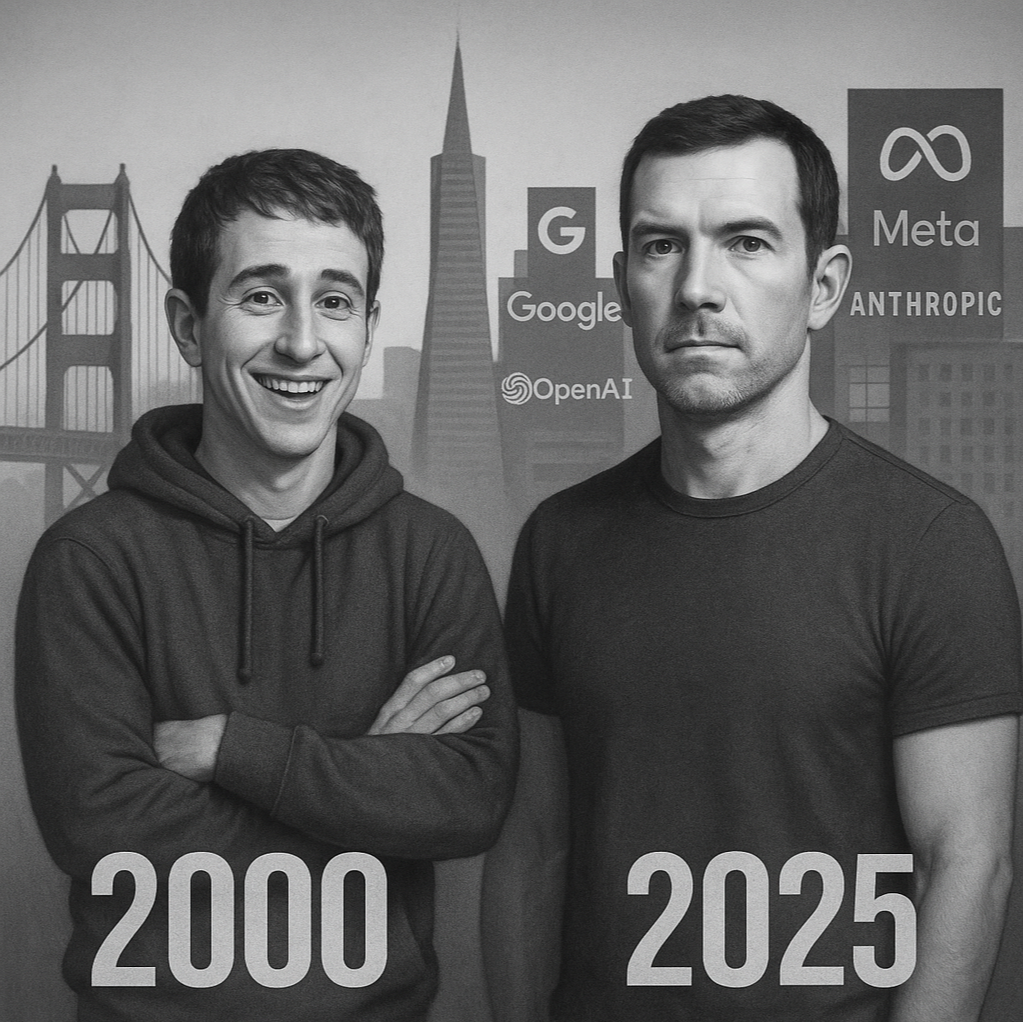
The Frontier & The Fortress
Is questioning the AI claims and buzzy applications the same as misunderstanding what the internet was going to be twenty-odd years ago? To make sense of it, I found myself returning to 8 comparisons of what feels different (and doesn’t) between then and now.

Not ‘CAN WE’ but ‘should we’
AI ROI is too often framed around efficiency — time and money saved. But efficiency alone is not a strategy. This post explores why the better question is “How do we use AI to make our products and services better?” and how reframing ROI helps organizations move from extraction to innovation.

ARE WE (WO)MEN OR MACHINES?
Talking about AI as if it's human reinforces a misunderstanding of what AI is and isn’t, and more importantly what we can reliably trust it to do. This is not to slam AI. As I’ve said many times, the technology itself is neither good nor bad. Our understanding, application, and business models based around it…. that’s another story.